Choosing a Casino API provider is a product, engineering and operations decision. Attractive demos matter, but your team will also depend on the supplier when a wallet request times out, a player questions a round or your platform needs a new game configuration.
The best starting point is a written checklist tied to your business. This guide explains how to compare supplier models, review a wallet connection and ask useful questions about Casino API pricing. It also shows where DesiAPI’s own six-game offering fits, so you can decide whether it matches your requirements.
1. Define what you need the provider to supply
Write down the gap you are trying to fill. Do you need a focused set of games for an existing website, a large multi-studio catalogue or a wider platform that also manages player accounts? Those are different buying decisions, even when all three proposals contain the phrase Casino Games API.
A requirements brief should identify your existing backend, player account system, wallet ownership, selected game categories, target devices, intended markets and expected traffic. Separate launch requirements from future possibilities. This makes supplier conversations more useful and reduces the risk of comparing unrelated packages.
2. Understand game ownership and distribution
Ask who developed each game and who has the right to supply it to your business. Confirm the product name, version and any market restrictions in the proposal. A format label such as crash, roulette or mines does not establish ownership or prove that two products are interchangeable.
| Supplier | Publicly described model | Useful evaluation question |
|---|---|---|
| SPRIBE | Game developer known for its Aviator product. | Are you requesting that specific product and an authorised supply route? |
| SOFTSWISS | Game aggregation connecting multiple studios. | Which studios and titles are actually available for your scope? |
| Slotegrator APIgrator | Multi-provider game content integration. | What content and commercial scope does your agreement cover? |
| Hub88 | Game aggregation and operator tools. | Does the catalogue and integration fit your platform requirements? |
| DesiAPI | Its own six game implementations for existing platforms. | Do these game experiences and wallet connections meet your launch needs? |
This is a supplier-model overview based on official descriptions, not a ranking or a claim that the services are equivalent. Validate the current offering and contract directly with each supplier. Catalogue size alone does not establish fit for your platform.
DesiAPI provides its own Aviator-style Crash, WinGo, Mines, Roulette, Dragon Tiger and Fortune Wheel implementations. It is not affiliated with SPRIBE and does not supply SPRIBE’s Aviator. If you are specifically searching for an Aviator game API, establish that distinction before discussing integration.
3. Evaluate the games your customers will actually use
Try the relevant game experiences on desktop and mobile. Look at control placement, bet confirmation, result clarity, round history and the route back to your website. A polished screenshot cannot show how a game behaves during a slow connection or an expired session.
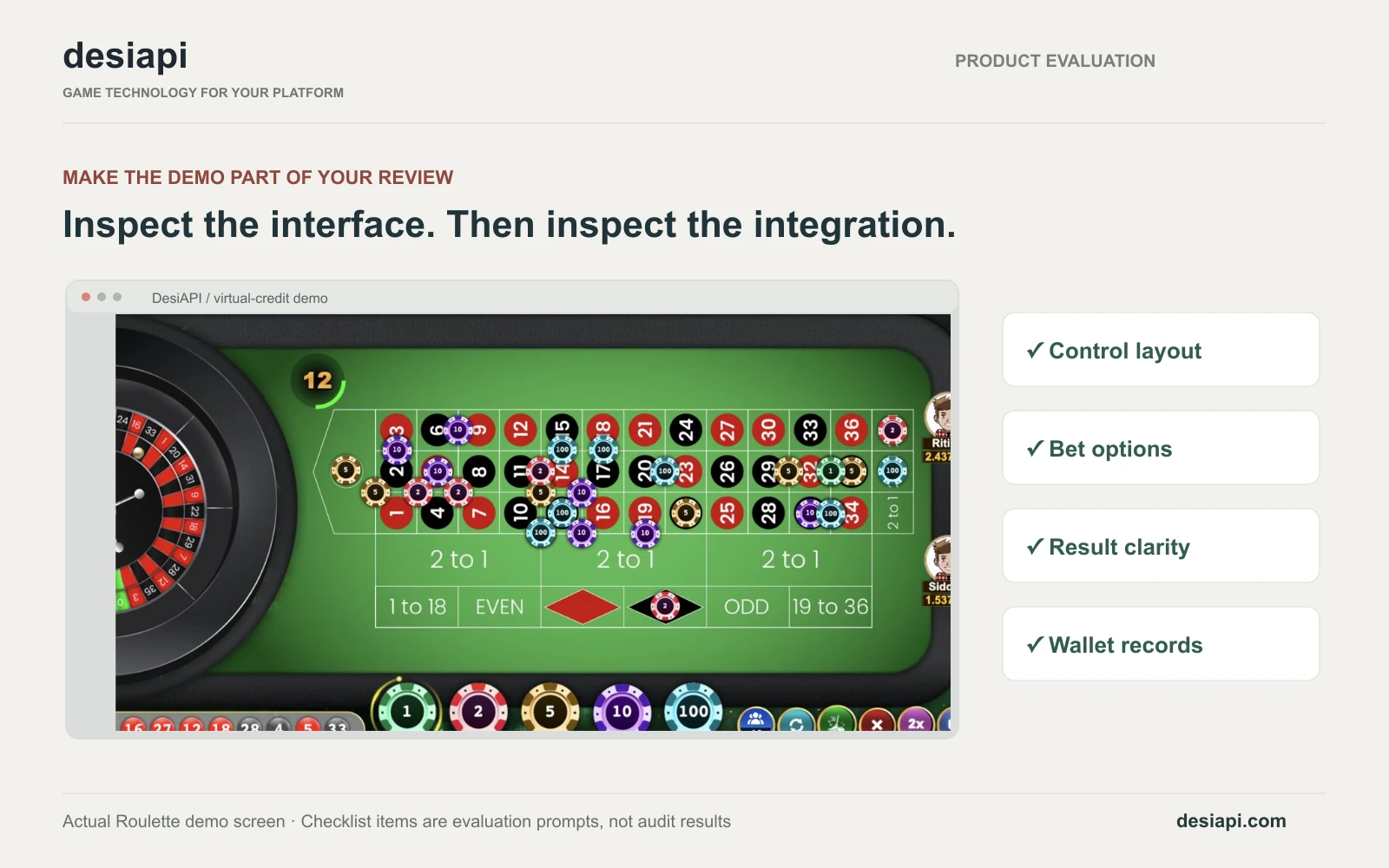
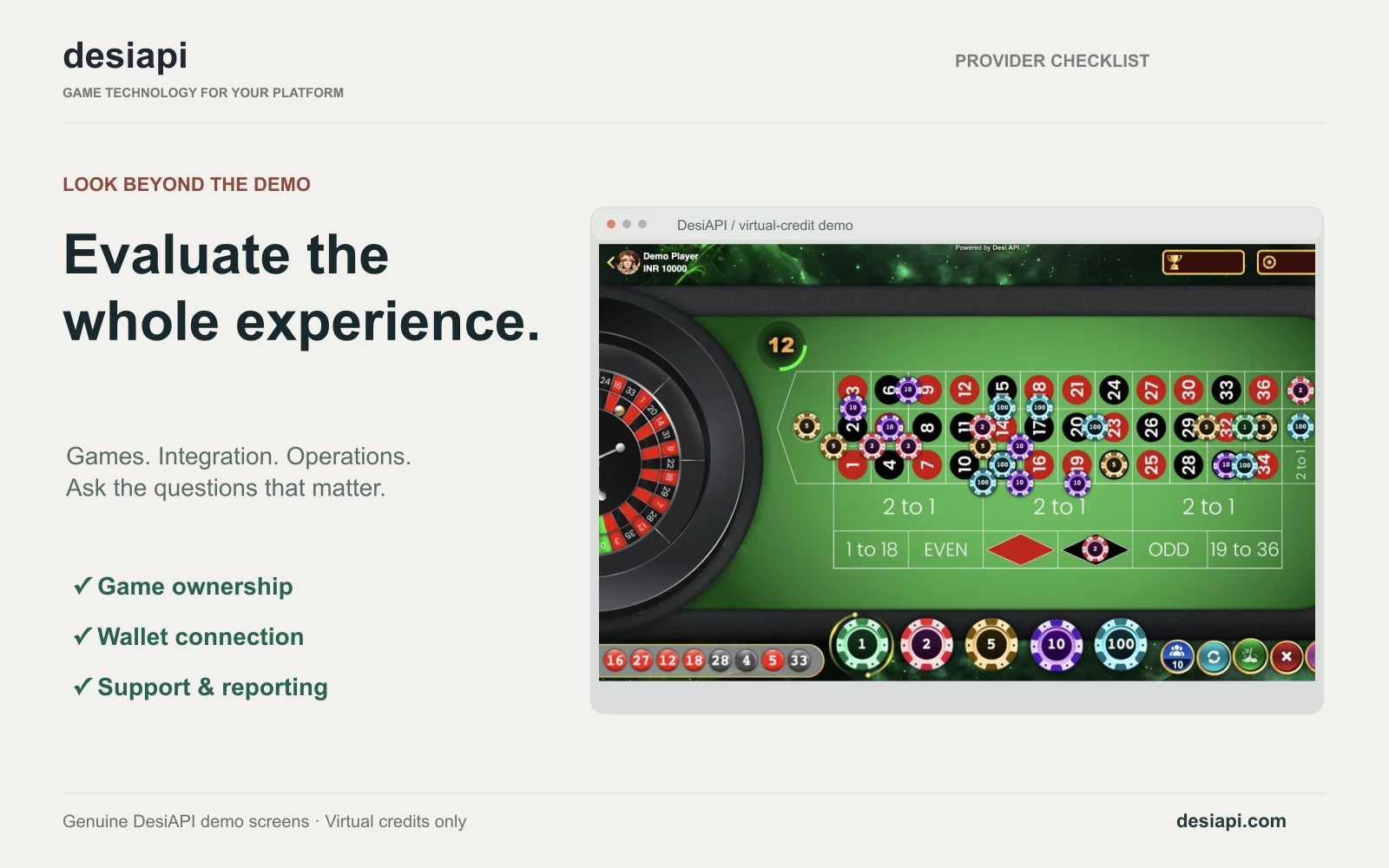
A Crash game API introduces timing-sensitive cash-out interactions. A WinGo game API needs clear round deadlines. A Mines game API has an active decision sequence that may continue across a reconnect. For a Roulette game API, the betting table and outcome records need careful review. With a Dragon Tiger game API or Fortune Wheel game API, check the exact result rules and wallet presentation.
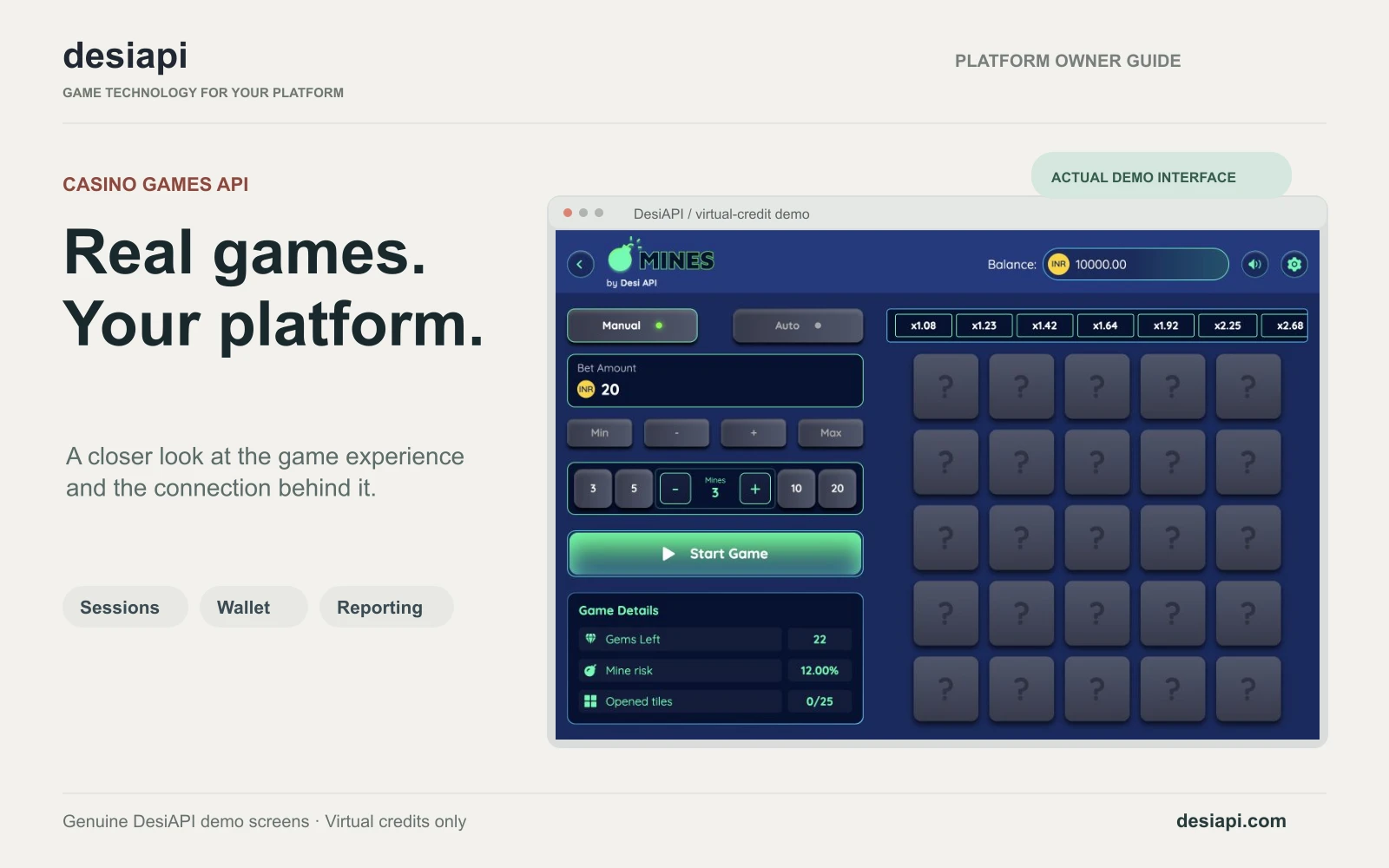
The DesiAPI catalogue and virtual-credit demos provide an initial view of these experiences. Public demos have no deposit or withdrawal path and no monetary value. Use a separate integration environment to evaluate your actual player and wallet connection.
4. Inspect the wallet contract before estimating development
Request the current documentation and review session creation, balance checks, debit, payout and refund handling with your backend developer. Ask how operations are identified, authenticated and reconciled. A provider should explain what happens when the sender does not receive a response after your wallet has committed a change.
- Identity: how are the business, player, game session and round connected?
- Authentication: which credentials protect API access and wallet callbacks?
- Amounts: what currency, precision and payout definitions apply?
- Duplicates: how does a repeated operation refer to its original outcome?
- Recovery: what is the documented process for uncertain or pending operations?
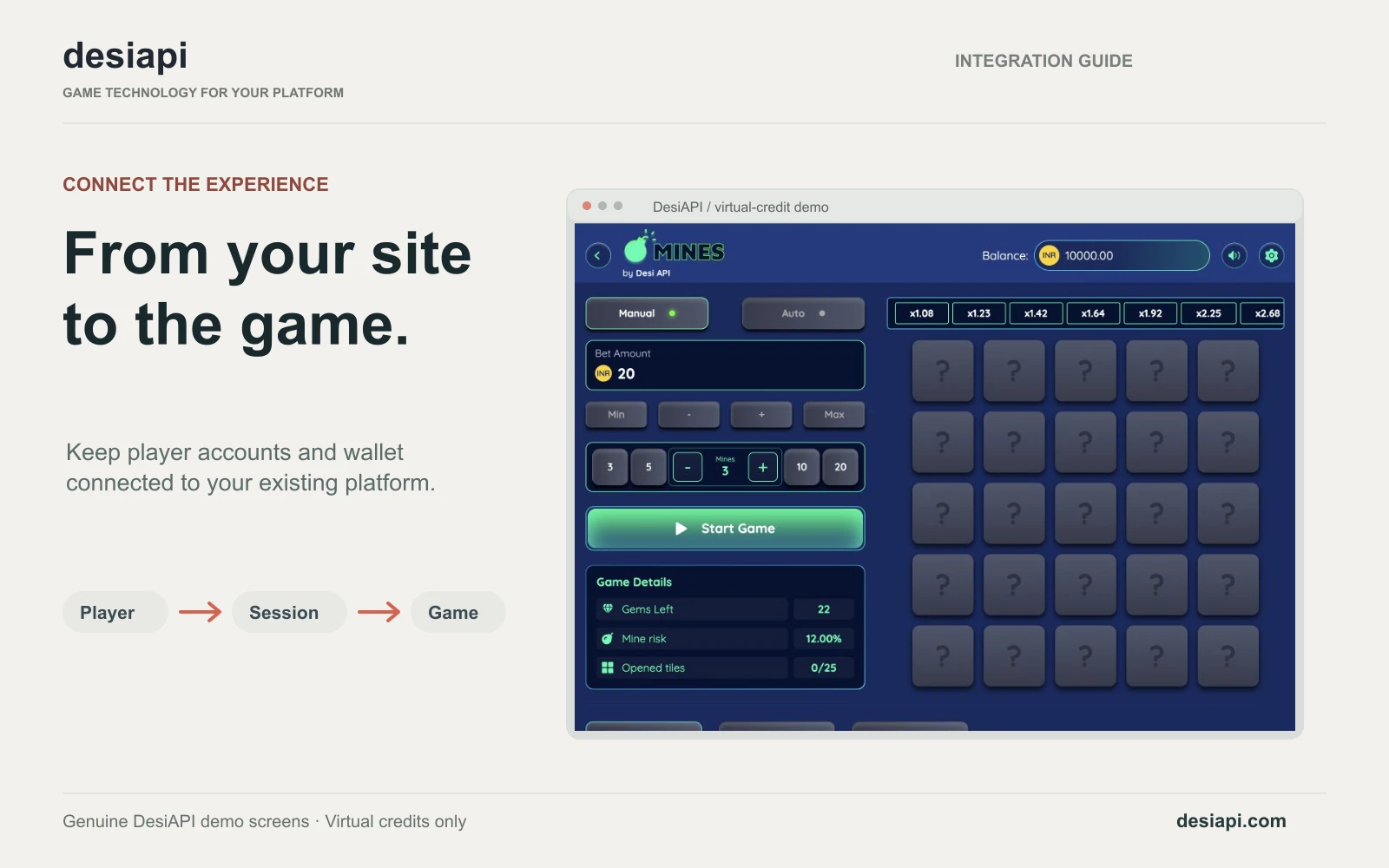
DesiAPI connects games with existing player accounts and wallets through sessions, balance checks and gameplay callbacks. Your team implements the wallet endpoints. Use the Casino API integration guide to prepare architecture questions, then obtain the actual protocol from the team before coding.
5. Ask for operational evidence and usable reporting
Ask the supplier to walk through a sample round in the administrator panel. Your support team should be able to understand the player, stake, result and related wallet activity. Confirm which reports are available and whether the records meet your reconciliation process; request an export demonstration if exports are a requirement.
Review administrator permissions and the scope of each game setting. Who can change a configuration, and how are changes coordinated with active play? DesiAPI provides administrator controls, game settings, round history and reporting. Confirm the particular controls available to your account rather than assuming a feature from a competitor’s back office exists here.
For reliability claims, ask for the actual service definition: what is measured, which exclusions apply, who responds to incidents and how escalation works. Avoid translating marketing descriptions into an assumed uptime commitment. Any service level must be confirmed in your agreement.
6. Compare Casino API pricing on equal terms
A low headline price can cover a narrower service than another supplier’s quote. Ask for a written scope and identify which fees are fixed, which depend on usage and which can change as you add games or environments. Do not assume a public price from a different provider applies to your project.
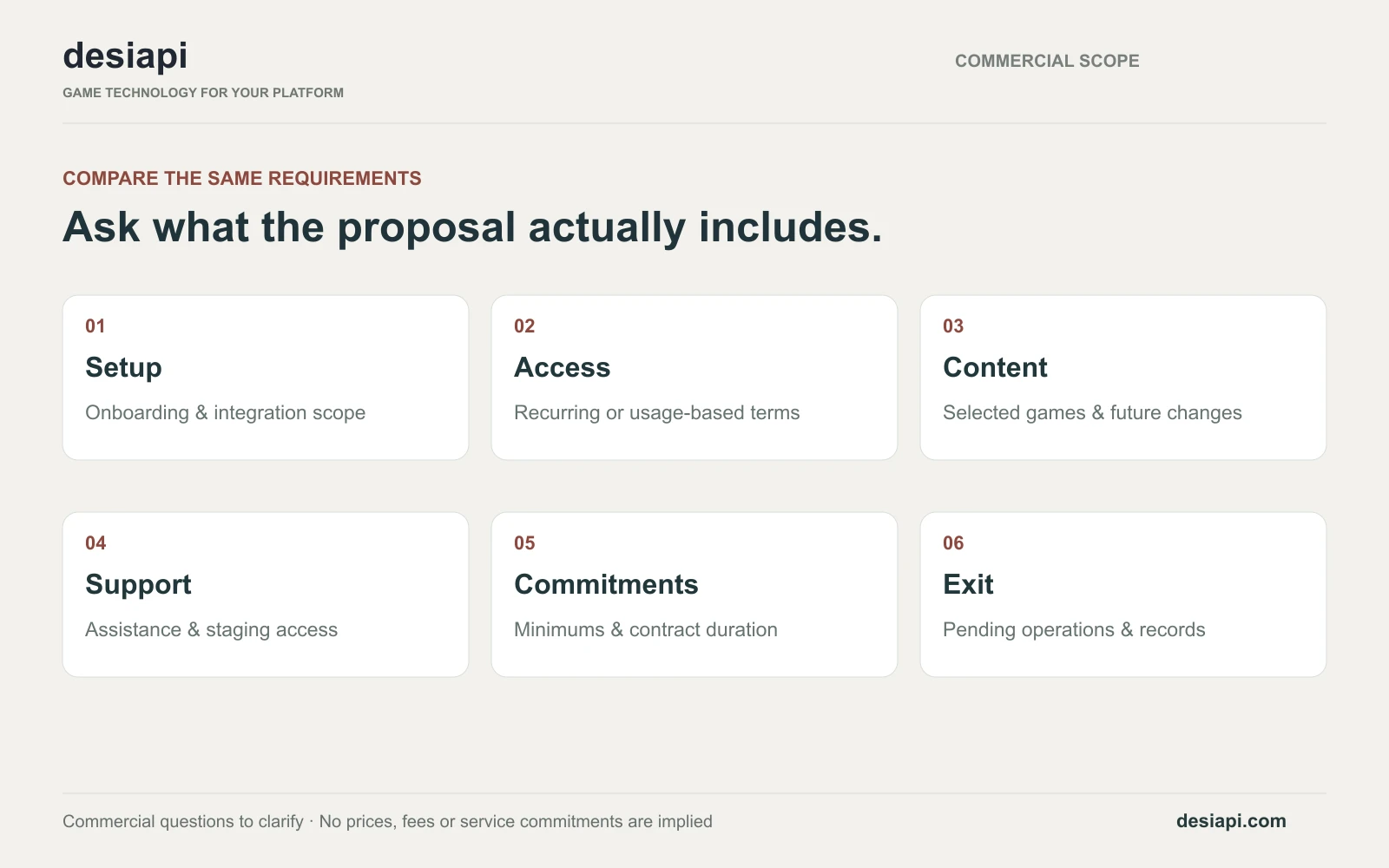
| Cost area to clarify | Question for the proposal |
|---|---|
| Setup and onboarding | Is there a one-time fee, and what work does it include? |
| Ongoing access | Is the commercial model fixed, usage-based, revenue-based or another structure? |
| Minimum commitments | Are minimum charges, deposits or contract periods applicable? |
| Content scope | Are the selected games included, and what happens when scope changes? |
| Support and environments | Which assistance and staging access are covered? |
| Exit and reconciliation | How are outstanding operations and reporting access handled on termination? |
These are questions to ask, not a claim that DesiAPI charges every listed fee. DesiAPI pricing should be confirmed directly against your selected games and integration needs. Also budget for your own development, monitoring and support, since those costs remain part of operating the connection.
7. Verify market and product requirements
Ask for evidence supporting any licence, testing or certification claim relevant to your intended operation. Check the entity, exact game or service, version, jurisdiction and scope of the evidence. A certificate relating to one supplier or product should not be assumed to apply to another.
This article does not claim that DesiAPI holds a particular regulatory approval or that an integration authorises operation in any market. Establish the requirements for your intended business with qualified advisers and request relevant product evidence directly from the supplier. Treat this as a purchasing requirement to resolve before a live launch.
8. Use a short scorecard for the final decision
Mark each requirement as confirmed, pending or unsuitable, and keep the supporting documentation beside it. A numerical total can hide a critical gap: if wallet recovery or a required market condition is unresolved, record it as a launch dependency even when the demo looks excellent.
- Product fit: the exact games, ownership and delivery model are clear.
- Technical fit: your team understands sessions, callbacks and recovery.
- Operational fit: history, reporting, permissions and escalation are demonstrated.
- Commercial fit: pricing, responsibilities and contract scope are written down.
- Launch readiness: the integration review and outstanding dependencies have an owner.
Frequently asked questions
Is the largest catalogue always the best choice?
Catalogue size matters when you need breadth across many studios. A focused provider may be relevant when its own games meet your requirements. Compare the actual games, integration and operations you need, rather than assuming size alone determines suitability.
What should I include in an initial enquiry?
Send your website or application, backend stack, selected games, wallet model, intended markets, expected traffic and launch priorities. Ask for documentation, a demonstration of administration tools and a scoped commercial proposal.
Can I choose a provider based only on the demo?
A demo is a useful first step. The decision also needs a wallet review, reporting walkthrough, commercial scope and confirmation of any applicable product requirements. Keep evidence for each item before approving production access.
Discuss your requirements with DesiAPI
If your platform needs DesiAPI’s own six-game catalogue, send the team your integration brief. Start with the game experiences you need and the systems you already operate. For background before that conversation, read the complete Casino Games API guide and use the scorecard above to keep the evaluation concrete.
Sources and further reading
For supplier models and integration context, see SPRIBE’s company overview, SOFTSWISS Game Aggregator, Slotegrator APIgrator and Hub88. These are independent providers’ own descriptions. Their services, commercial terms and availability must be checked directly; references do not imply a partnership with DesiAPI.
Review the Casino API integration flow, explore API pricing and quote requirements, or send your project brief to DesiAPI.