Direct Casino Games API Provider vs Game Aggregator: How to Choose
The online gaming industry has changed significantly over the last few years. Businesses are no longer limited to building every game from scratch or depending on a single software platform. With the help of a Casino Games API, gaming businesses can connect different games to their existing websites and applications.
However, when searching for a casino game integration solution, one common question comes up: Should you work directly with a casino games API provider or choose a game aggregator?
Both options have their own advantages. A game aggregator can provide access to multiple game studios through one integration, while a direct game API provider may offer a more focused integration experience with its own game implementations.
The right choice depends on your business requirements, available development resources, game catalogue, technical flexibility and long-term plans.
In this article, we will explain the differences between direct casino game API providers and game aggregators, how their integration models work, what to consider when comparing Casino API pricing, and how to select a solution for your existing gaming platform.
What Is a Casino Games API?
A Casino Games API is a technical interface that allows a gaming website, mobile application or software platform to connect with casino games through API communication.
Instead of developing every game independently, businesses can integrate supported games into their existing platforms using an API.
A typical Casino API integration connects several important components:
- Player accounts and authentication
- Game session creation
- Player wallet and balance checks
- Bet placement and transaction requests
- Payout and refund callbacks
- Game results and round history
- Game settings and administrator controls
- Reporting and transaction monitoring
For example, suppose you already operate a gaming website with registered users and an existing wallet system. You want to add games such as Crash, Mines, Roulette and Dragon Tiger.
A Casino Games API can help connect these games with your existing platform without requiring you to build the entire gaming experience from the beginning.
The actual integration process depends on the API provider, supported features and your existing software architecture.
What Is a Direct Casino Games API Provider?
A direct Casino Games API provider develops or supplies its own game implementations and offers API connectivity to businesses that want to integrate those games into their platforms.
In this model, you work with the provider responsible for the games and the associated integration interface rather than accessing a collection of unrelated studios through a third-party aggregator.
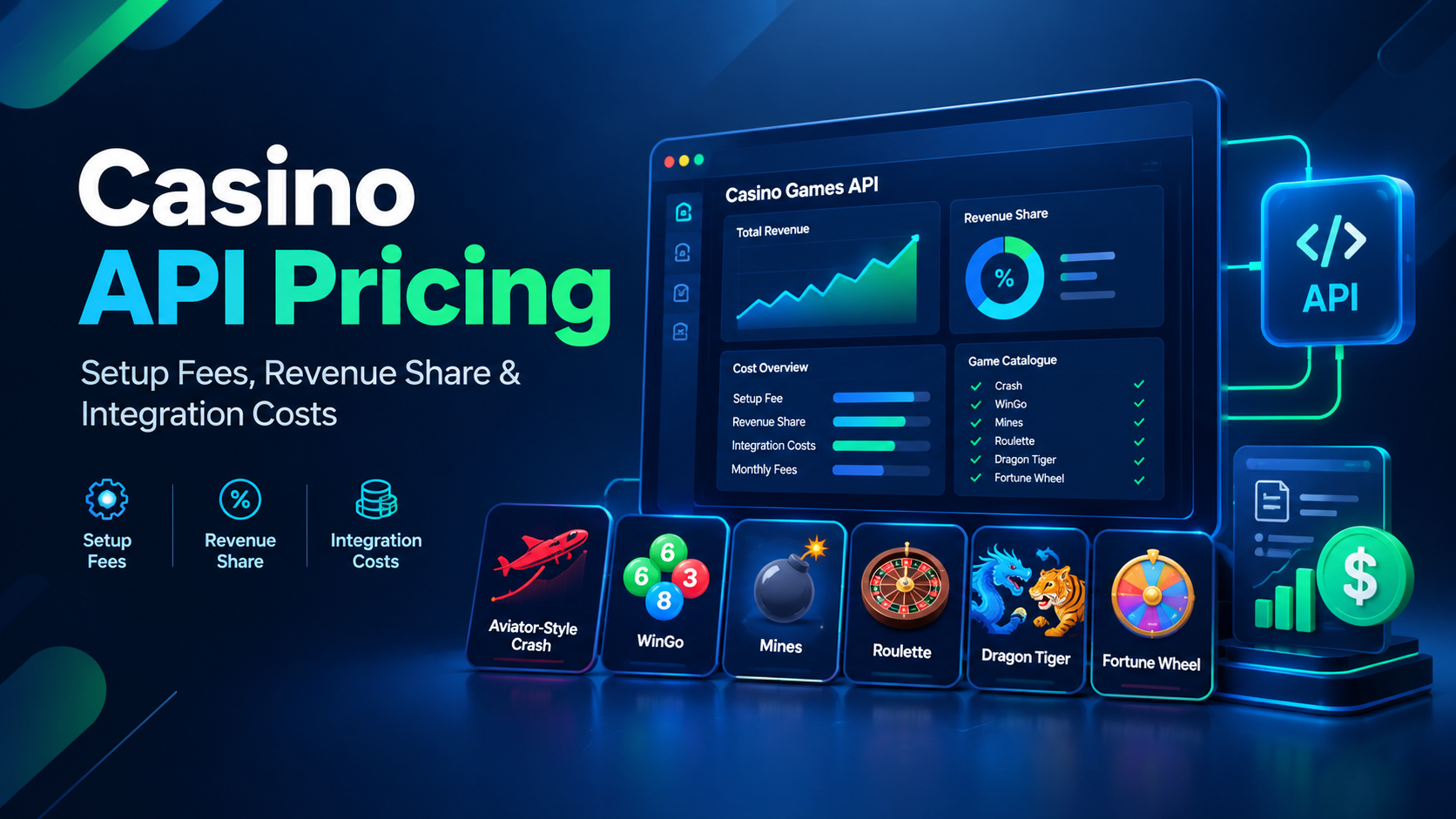
For example, a provider may offer several games through its own API catalogue, including:
- Crash games
- Aviator-style games
- WinGo games
- Mines games
- Roulette games
- Dragon Tiger games
- Fortune Wheel games
The provider supplies the supported game integration, while your development team connects it to your existing player accounts, backend and wallet infrastructure.
How Direct Game API Integration Works
A typical integration process looks like this:
- Your business selects a game API provider.
- The provider shares the required API documentation and credentials.
- Your developers connect your backend with the provider's API.
- Your platform creates and manages player game sessions.
- Balance checks and bet requests are processed through the integration.
- Payout and refund callbacks update the relevant wallet records.
- Your team tests the complete flow before production deployment.
The biggest advantage of this model is having a direct technical relationship with the provider responsible for the games.
It can also make it easier to understand which components are managed by your platform and which are handled by the API provider.
What Is a Casino Game Aggregator?
A casino game aggregator is a platform that connects multiple independent game developers or studios and makes their games available to operators through a unified integration.
Instead of integrating separately with every game studio, a business can connect to the aggregator's API and access its supported game catalogue.
This approach is particularly useful for operators who want a large variety of games without managing numerous individual technical integrations.
For example, an aggregator might provide access to:
- Slot games from multiple studios
- Live dealer games
- Crash games
- Table games
- Card games
- Instant games
- Other casino game categories
The aggregator generally manages the connection between its platform and the participating game providers.
How a Game Aggregator Works
The process usually follows this structure:
- The gaming business selects an aggregator.
- The aggregator provides API documentation and integration access.
- The business connects its platform with the aggregator.
- Available games are activated through the aggregator.
- Player sessions and wallet communication are handled according to the integration model.
- The aggregator coordinates supported game content from its partner studios.
The main benefit is convenience. One integration can provide access to a much larger selection of games.
However, businesses should also understand the aggregator's commercial terms, technical responsibilities and individual game availability before signing an agreement.
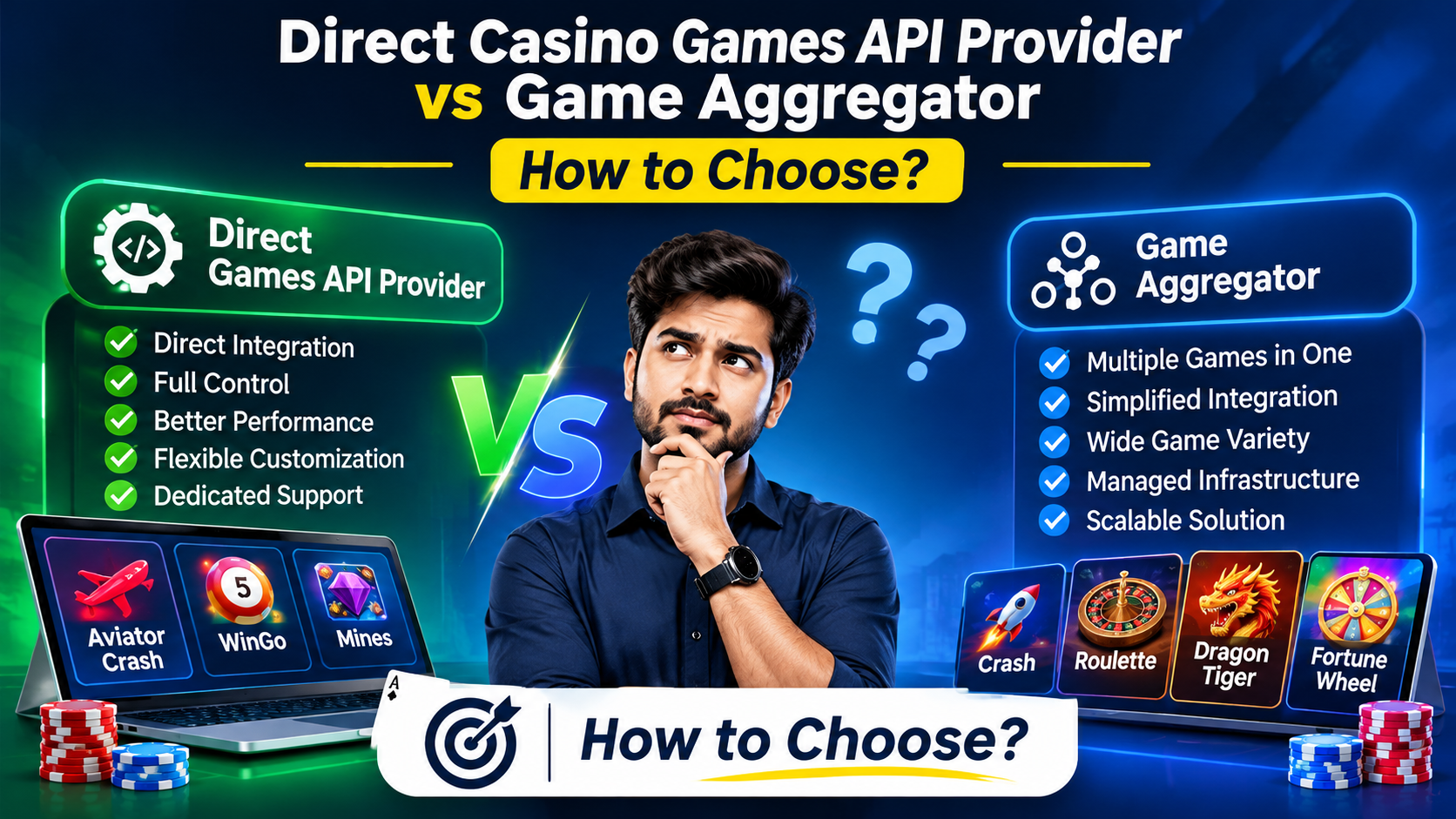
Direct Casino Games API Provider vs Game Aggregator: Key Differences
Both integration models help businesses add games to existing platforms, but their business and technical structures are different.
Here is a practical comparison.
| Comparison | Direct Game API Provider | Game Aggregator |
|---|---|---|
| Game ownership | Provider's own implementations | Multiple partner studios |
| Game catalogue | Focused catalogue | Usually larger catalogue |
| Integration | Direct provider API | Unified aggregator API |
| Game selection | Based on provider offerings | Based on partner availability |
| Technical communication | Direct with provider | Through aggregator |
| Commercial structure | Provider-specific terms | Aggregator-specific terms |
| Game updates | Managed by the provider | Coordinated across studios |
| Expansion | Add supported provider games | Activate additional supported studios |
| Wallet integration | Depends on API capabilities | Depends on aggregator capabilities |
| Best suited for | Focused game integration | Broad game catalogue expansion |
It is important to understand that neither model is automatically better. The right choice depends on what your business actually needs.
1. Game Catalogue and Variety
Game availability is one of the first things businesses should consider when selecting a Casino API provider.
A direct provider usually offers a specific collection of games developed or supplied through its own technology.
This can be useful when your platform has a clear game strategy and you want to integrate selected categories rather than hundreds of unrelated titles.
For example, a focused game catalogue may include:
Crash Games: Fast-paced multiplier-based game experiences.
WinGo Games: Colour and number-based prediction formats.
Mines Games: Interactive grid-based game experiences.
Roulette Games: Classic table-style gameplay.
Dragon Tiger: A card-based game format.
Fortune Wheel: A wheel-based instant game experience.
On the other hand, aggregators generally focus on providing a wide range of games from different developers.
If your priority is accessing a large number of third-party game studios, an aggregator might be a better fit.
But if you only need selected game categories and prefer working with a provider that manages its own implementations, direct integration deserves consideration.
2. Casino API Integration and Development Process
Integration quality is another important factor.
A good Casino Games API should make it possible for developers to connect the games with their existing platform without unnecessary complexity.
The important technical areas include:
- API authentication
- Player identification
- Session management
- Game launch requests
- Balance validation
- Bet processing
- Payout callbacks
- Refund handling
- Error responses
- Transaction verification
In direct integration, your development team communicates with the game provider's API.
In an aggregator model, the communication takes place through the aggregator's integration layer, which connects to multiple game studios.
Neither approach guarantees an easier integration. The quality of documentation, API design, error handling and technical support matters much more than the model alone.
Before selecting a provider, ask for API documentation and understand the complete integration flow.
3. Player Wallet and Balance Management
Wallet integration is one of the most important parts of any gaming platform.
If you already have a website or application with registered players and a wallet system, you should not overlook how the game API communicates with that wallet.
A well-designed integration should clearly define how balance checks, bets, payouts and refunds are processed.
For example, consider this basic transaction flow:
Step 1: Player Opens a Game
Your platform identifies the player and creates the required game session.
Step 2: Balance Check
The game integration requests the player's available balance from your backend.
Step 3: Bet Request
When a player places a bet, the API sends a transaction request to the platform.
Step 4: Game Result
The game processes the round and generates the applicable result.
Step 5: Payout or Refund
The integration sends the relevant payout or refund callback to your wallet system.
Step 6: Transaction Update
Your platform updates the player's balance and stores the transaction details.
Both direct providers and aggregators can support wallet integration, but their exact callback structures and transaction responsibilities can vary.
Always check how the API handles duplicate requests, failed transactions, timeouts and transaction reversals.
4. Technical Control and Flexibility
Technical flexibility can become important as your platform grows.
With direct integration, your team has a direct relationship with the provider responsible for the game implementation.
This can make communication about game-specific features, updates and integration requirements more straightforward.
With an aggregator, you work through a central integration layer. This can simplify the overall architecture when multiple studios are involved.
However, you may have to follow the aggregator's supported configuration options and technical rules.
Before making a decision, check whether the provider supports:
- Game-specific settings
- Session management
- Transaction history
- Round history
- Detailed reporting
- Administrator controls
- API error monitoring
- Integration testing environments
The goal is not simply to connect games. It is to make sure your development team can manage the integration properly after launch.
5. Casino API Pricing: Which Model Is More Cost-Effective?
Casino API pricing is another major consideration for gaming businesses.
There is no universal pricing structure across all providers. Some offer revenue-sharing arrangements, while others may have setup charges, monthly fees, minimum commercial commitments or custom pricing agreements.
A direct provider and an aggregator may also calculate their charges differently.
Common Pricing Factors
When comparing a Casino API provider, ask about the following:
Integration Fees: Is there an initial technical setup or integration charge?
Monthly Charges: Does the provider charge a recurring platform or maintenance fee?
Revenue Sharing: Is there a revenue-share percentage or another usage-based commercial arrangement?
Minimum Commitments: Are there minimum monthly payments or business-volume requirements?
Additional Features: Are reporting, administrator controls and technical support included?
Game Expansion: Are there additional charges when adding more games?
Direct Provider vs Aggregator Pricing
A direct provider may offer a more focused commercial arrangement for its own games.
An aggregator may provide a bundled commercial arrangement covering multiple studios.
However, it would be incorrect to assume that direct integration is always cheaper or that aggregation is always more expensive.
You should compare the total cost of ownership rather than only the initial integration price.
This includes development time, ongoing maintenance, technical support, commercial fees and future expansion costs.
6. Scalability and Future Expansion
Your current requirements may be different from your requirements six months or one year later.
A business may initially want only two or three games but later decide to expand its catalogue.
This is why scalability should be part of your provider selection process.
With a direct Casino Games API provider, expansion depends on the provider's available game portfolio and supported API capabilities.
With an aggregator, you may be able to activate additional games from different studios through the existing integration.
However, a larger catalogue is only useful if the games are relevant to your target audience and available for your intended markets.
Choose an integration model that supports your actual business roadmap rather than selecting a provider based only on the number of available games.
7. Technical Support and Documentation
Good technical support can save a lot of development time.
Even a well-designed API can create problems during implementation if the documentation is incomplete or the integration team cannot get answers when required.
Before selecting a Casino API provider, ask these questions:
- Is complete API documentation available?
- Are integration examples provided?
- Is technical assistance available during development?
- Is there a testing or demo environment?
- How are API errors communicated?
- How are transaction issues investigated?
- Are updates and maintenance communicated in advance?
You should also check whether the provider explains its responsibilities and your development team's responsibilities clearly.
A reliable technical relationship is important for maintaining a stable integration over time.
Popular Casino API Providers and Game Aggregation Platforms
When researching casino game integration solutions, you will come across several established companies.
Understanding their business models can help you evaluate what type of solution you need.
SPRIBE
SPRIBE is a recognised iGaming game developer known for its Aviator crash game and other gaming products.
Its official product portfolio also includes BroadHub, an aggregation product, alongside its game development and platform offerings.
Businesses researching an Aviator game API or Crash game API can study SPRIBE's game portfolio and distribution model.
SOFTSWISS
SOFTSWISS provides iGaming software solutions, including its Game Aggregator.
Its aggregation solution connects operators with a large portfolio of third-party game providers through a unified integration.
This model is particularly relevant for businesses looking to expand their game catalogue without building individual integrations for every studio.
Slotegrator
Slotegrator offers APIgrator, a game aggregation solution that provides access to games from multiple developers through a single integration.
Its approach focuses on simplifying game distribution and providing operators with access to different casino game categories.
Where Does DesiAPI Fit?
DesiAPI follows a different approach from a multi-studio aggregation platform.
It provides its own game implementations through API-based integration, allowing businesses to connect supported games with their existing websites and applications.
Its current catalogue includes:
- Crash
- WinGo
- Mines
- Roulette
- Dragon Tiger
- Fortune Wheel
DesiAPI also provides integration capabilities for player sessions, balance checks, bet processing, payouts, refunds, administrator controls, round history and reporting.
For businesses that want to integrate these supported game experiences into an existing platform, this is an alternative model worth evaluating.
Why Businesses Consider DesiAPI for Casino Games API Integration
Choosing a game API is not only about the games themselves. Your platform also needs a technical connection that works with your existing software.
DesiAPI is designed for businesses that already have a website or application and want to add supported games through API integration.
1. Multiple Game Categories
DesiAPI offers six game implementations covering different gaming formats.
These include Crash, WinGo, Mines, Roulette, Dragon Tiger and Fortune Wheel.
Businesses can explore the available catalogue and choose the games that match their platform requirements.
2. Existing Player Account Integration
Your business can connect the supported game API with its existing player account structure.
This helps maintain a connection between the platform's player records and game sessions.
3. Wallet Communication
The API supports balance checks and callbacks related to bets, payouts and refunds.
This allows developers to connect the games with their existing wallet infrastructure according to the supported transaction flow.
4. Administrator Controls
Managing an integrated gaming platform requires more than launching games.
DesiAPI also provides administrator controls, game settings, round history and reporting features to support platform management.
5. Demo Access
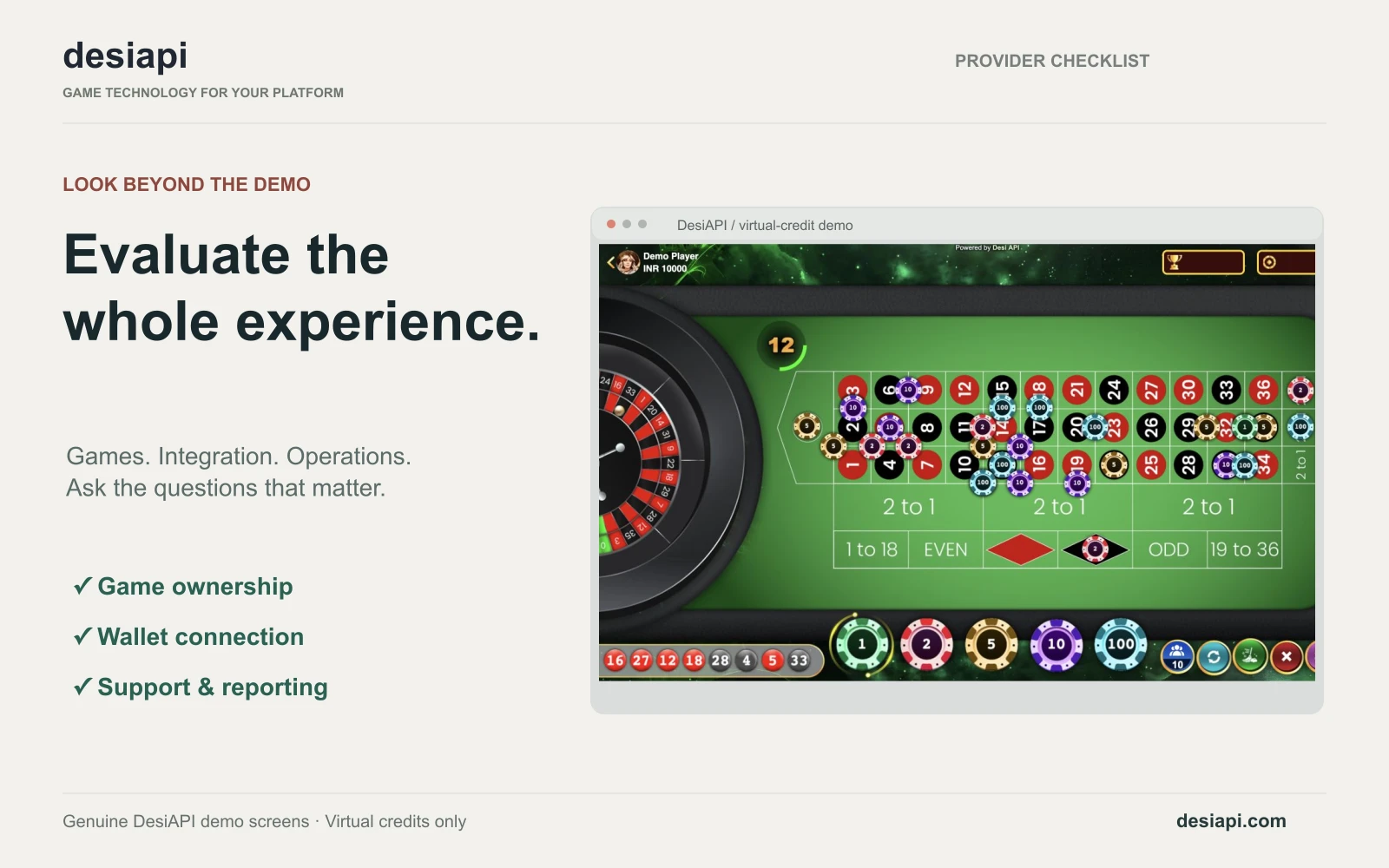
Businesses and developers can explore public game demos with virtual credits.
This is useful for understanding the game experience and evaluating the integration requirements before moving forward.
6. Designed for Existing Websites and Applications
You do not necessarily need to replace your existing website or application to explore a game API integration.
The purpose of the API is to connect supported game experiences with your existing platform, subject to technical compatibility and integration requirements.
If you are looking for a Casino API provider for your existing software, DesiAPI is worth exploring.
How to Choose the Right Casino API Provider for Your Business
Before finalising a provider, take some time to evaluate the following points.
1. Check the Game Catalogue
Make sure the provider offers the games you actually need. Do not select a solution only because it advertises a large number of titles.
2. Review API Documentation
Your developers should be able to understand authentication, session creation, wallet communication and callback handling.
3. Understand the Wallet Structure
Confirm how balance checks, bets, payouts and refunds are handled.
4. Compare Complete Pricing
Understand setup charges, recurring fees, revenue-sharing terms and additional costs.
5. Check Demo Availability
A demo can help your team understand the game experience and identify questions before integration.
6. Evaluate Technical Support
Ask how integration issues, API errors and transaction problems are handled.
7. Verify Legal and Compliance Requirements
Game availability and regulatory requirements vary by jurisdiction. Verify the provider's applicable game rights, certifications and market permissions. Also make sure your own business has the licences and approvals required for its intended activities.
8. Think About Long-Term Expansion
Select a solution that can support your future technical and catalogue requirements.
Final Verdict: Direct Casino Games API Provider or Game Aggregator?
There is no single answer that works for every gaming business.
If your business wants access to games from numerous independent studios through one connection, a game aggregator may be the more suitable option.
If you want to integrate a focused catalogue of games directly from a provider that manages its own game implementations, a direct Casino Games API provider may be a better fit.
The most important factors are integration quality, wallet compatibility, technical documentation, commercial terms, support and long-term flexibility.
For businesses that already operate a gaming website or application and want to integrate Crash, WinGo, Mines, Roulette, Dragon Tiger and Fortune Wheel, DesiAPI provides an API-based solution worth evaluating.
Explore DesiAPI at https://desiapi.com/ to learn more about its available games, API integration capabilities and demo options.
Frequently Asked Questions (FAQs)
1. What is the difference between a direct Casino Games API provider and a game aggregator?
A direct Casino Games API provider offers its own game implementations through API integration. A game aggregator connects multiple independent game studios and provides access to their games through a unified API.
2. Which is better: a direct game API or an aggregator API?
It depends on your requirements. Direct integration can be suitable for businesses looking for a focused game catalogue and a direct provider relationship. Aggregators are useful when a business needs access to games from multiple studios through one integration.
3. What is required for Casino API integration?
Generally, you need API credentials, backend connectivity, player authentication, session management, wallet communication, transaction callbacks and proper integration testing. Exact requirements depend on the provider.
4. Can I integrate a Casino Games API into my existing website?
Yes. Many game API solutions are designed to connect with existing websites and applications. However, compatibility depends on your current technology stack and the API provider's integration requirements.
5. What is Casino API pricing?
Casino API pricing varies by provider and commercial arrangement. It may include setup charges, monthly fees, revenue sharing, minimum commitments or additional technical service charges.
6. What games can be integrated through a Crash game API?
A Crash game API connects a supported crash-style game to an existing platform. The actual game selection depends on the provider's catalogue and integration arrangements.
7. What is an Aviator game API?
An Aviator game API refers to an API integration for the Aviator game or an appropriately authorised Aviator-related integration. Businesses should verify official game rights and provider authorisation before integrating branded games.
8. Does DesiAPI provide multiple game APIs?
Yes. DesiAPI offers its own implementations of Crash, WinGo, Mines, Roulette, Dragon Tiger and Fortune Wheel through its API-based integration solution.
9. Can I connect my existing player wallet with DesiAPI?
DesiAPI supports player sessions, balance checks and callbacks for bets, payouts and refunds, allowing developers to connect the supported game integration with their existing wallet infrastructure.
10. Can I test games before integration?
DesiAPI provides public demos with virtual credits, allowing businesses and developers to explore the available game experiences.
11. Should I choose a provider based only on the number of games?
No. Game quality, technical compatibility, integration documentation, wallet handling, commercial terms and support are equally important.
12. How can I get started with DesiAPI?
Visit https://desiapi.com/ to explore the available games, review the integration options and learn more about the API solution.
About DesiAPI
DesiAPI provides casino game API integration solutions for gaming platform owners, operators, software development companies and developers. Its catalogue includes Crash, WinGo, Mines, Roulette, Dragon Tiger and Fortune Wheel, with API capabilities for player sessions, wallet communication, transaction callbacks and platform management.
Review the Casino API integration flow, explore API pricing and quote requirements, or send your project brief to DesiAPI.