Casino API Integration: Player Sessions and Wallet Connections Explained
Integrating casino games into an existing website or application involves more than simply adding a game link or displaying a game window. A complete Casino API Integration connects the game environment with the platform's player accounts, wallet system, and backend infrastructure.
For gaming platform owners, operators, and software developers, understanding how player sessions and wallet connections work is an important part of choosing the right Casino Games API.
A properly designed integration allows players to access games through their existing accounts while the platform manages important activities such as balance checks, bets, payouts, and refunds.
In this guide, we will explain how casino game API integration works, what player sessions are, how wallet connections operate, and which technical features businesses should consider before choosing a Casino API provider.
Whether you are integrating a Crash Game API, Aviator Game API, WinGo Game API, Mines Game API, Roulette Game API, Dragon Tiger Game API, or Fortune Wheel Game API, the basic integration concepts remain similar.
What Is Casino API Integration?
Casino API Integration is the process of connecting casino games with an existing website, mobile application, or gaming platform through an Application Programming Interface (API).
Instead of developing every game internally, a business can connect with a Casino Games API provider and make supported games available through its existing platform.
The API works as a communication layer between different systems. It allows the gaming platform and game environment to exchange information related to player sessions, game launches, wallet balances, bets, payouts, and transaction results.
For example, imagine a gaming business already has:
- A registered user database.
- A player login and authentication system.
- An existing wallet.
- A website or mobile application.
- An administrator dashboard.
The business wants to add new casino games without rebuilding its entire application.
With a suitable Casino API, the existing platform can connect to an external game environment while continuing to use its own player accounts and backend infrastructure.
This is one of the main reasons why businesses look for a reliable Casino API provider.
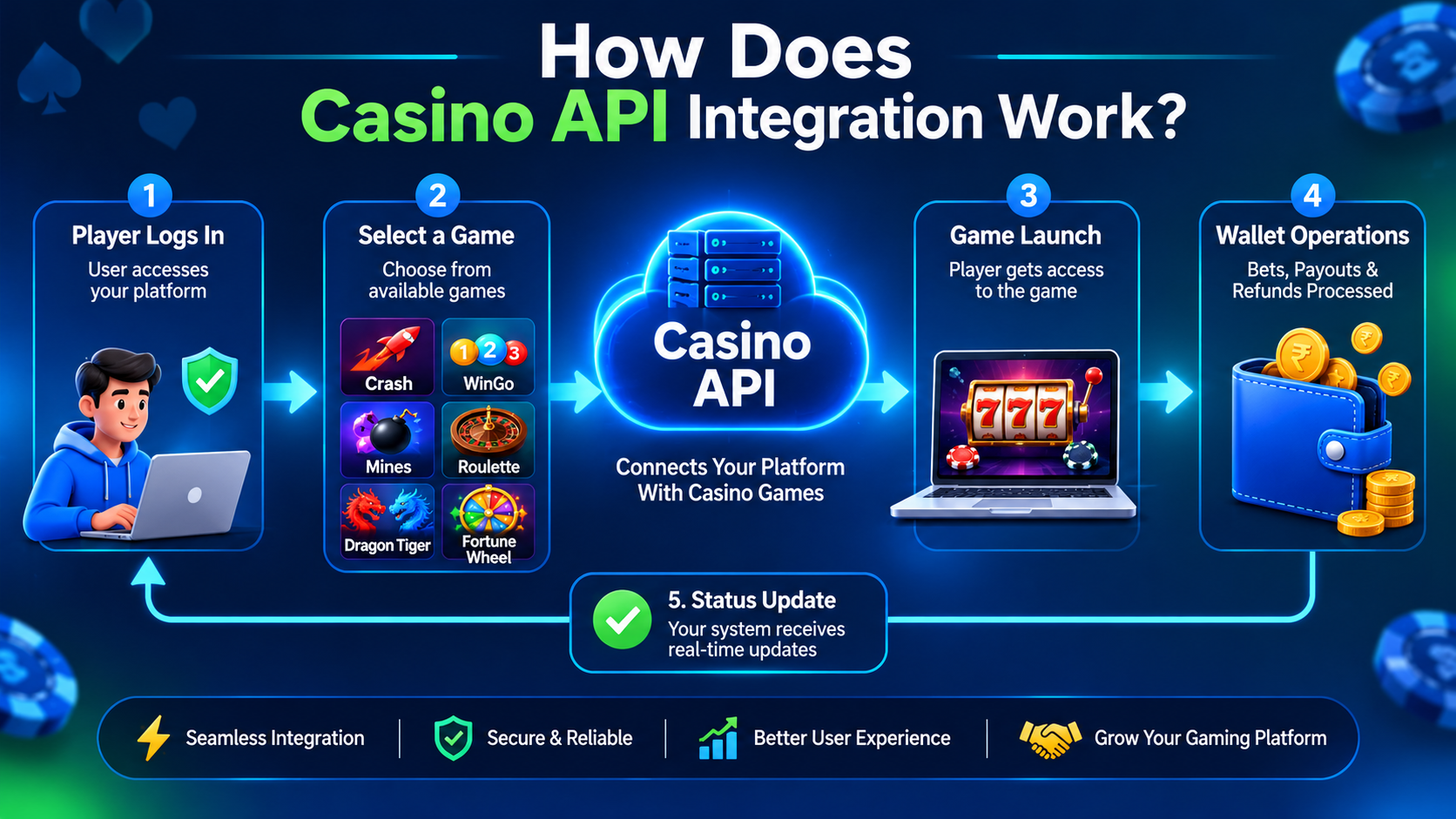
How Does Casino API Integration Work?
A typical Casino API Integration involves communication between three main components:
- The gaming platform.
- The game API provider.
- The player's existing wallet system.
The gaming platform manages user accounts and provides access to the games. The API provider handles game connectivity and communicates game-related events. The wallet system processes balance requests, bets, payouts, and refunds.
Basic Casino API Integration Flow
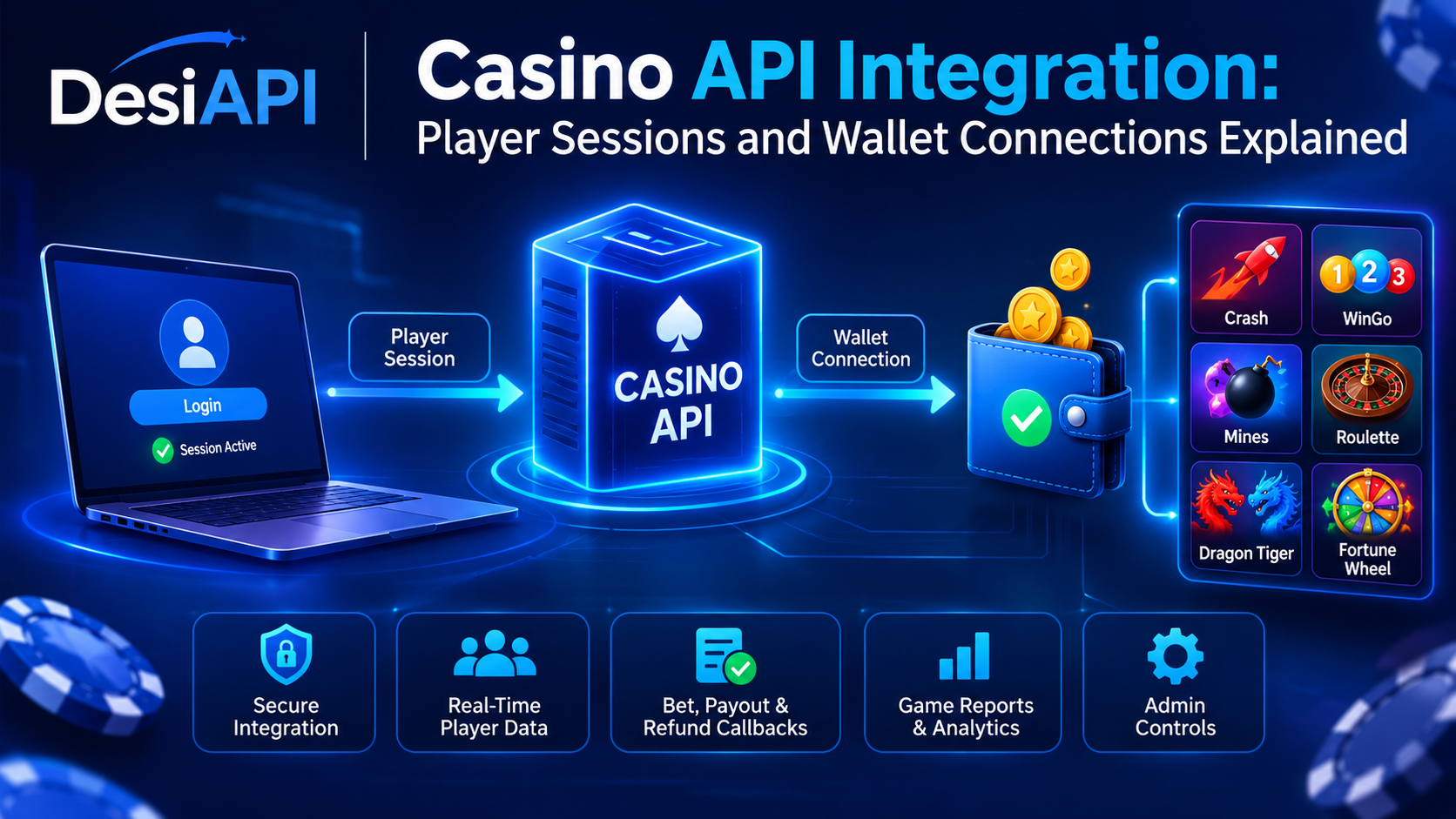
The general integration process looks like this:
- A player logs into the existing gaming platform.
- The player selects a game from the available game catalogue.
- The platform sends a request to the Casino Games API.
- The API creates or validates a player session.
- The player receives a game launch URL or supported game access method.
- The game requests wallet information when required.
- Bet and payout events are communicated through API callbacks.
- The platform updates the player's wallet and transaction records.
The exact process depends on the API architecture and integration documentation provided by the game provider.
What Are Player Sessions in Casino API Integration?
A player session is a temporary, controlled connection that allows an authenticated player to access a specific game through the gaming platform.
Think of a player session as a secure connection between the user's existing account and the game environment.
When a player clicks on a game, the platform usually sends information to the API provider to create a new session.
This information may include:
- Player ID or username.
- Game ID.
- Currency.
- Language preference.
- Session token or authentication details.
- Platform or operator identification.
After validating the request, the API can return a game launch URL or another supported access method.
The player can then enter the game without creating a completely separate account for every individual game.
Why Are Player Sessions Important?
Player sessions help maintain continuity between the platform and its games.
Some important benefits include:
1. Existing Player Accounts
Players can access supported games using their existing platform accounts.
2. Controlled Game Access
Session validation helps ensure that only authorised users can launch games.
3. Better User Experience
Players do not need to repeat the login process whenever they switch between supported games.
4. Session Management
The platform can manage session expiry, logout requests, and access restrictions according to its integration architecture.
5. Better Platform Monitoring
Session information can help administrators track game launches, active sessions, and technical issues.
A good Casino API Integration should have a clearly documented session creation and validation process.
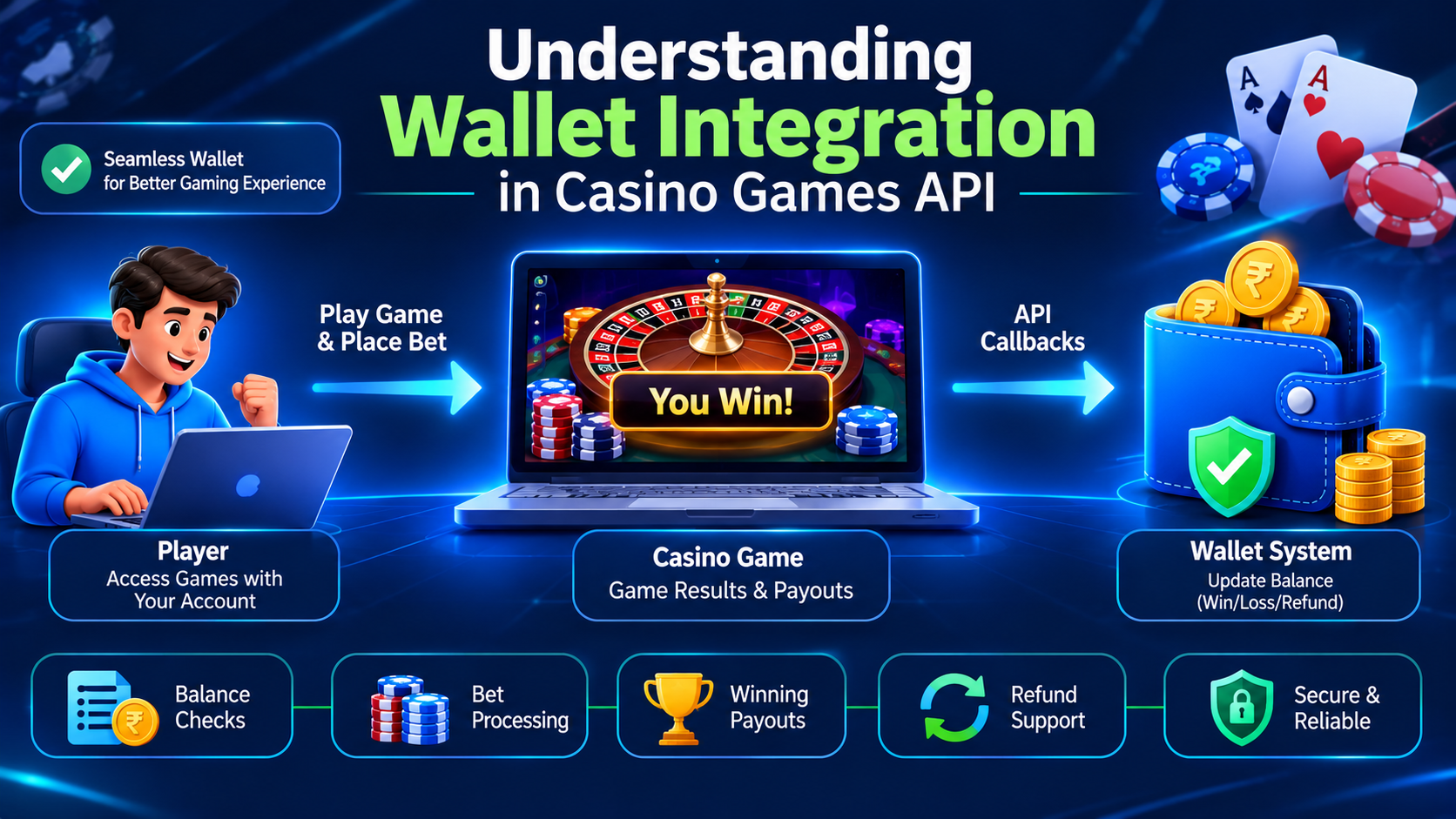
Understanding Wallet Integration in Casino Games API
Wallet integration is one of the most important parts of connecting casino games to an existing platform.
A wallet system maintains player balances and records financial transactions. During gameplay, the game environment needs to communicate with this wallet to process different events.
For example, when a player places a bet, the wallet needs to process the applicable debit. When a game produces a valid payout, the wallet needs to process the corresponding credit.
There are different wallet integration models available in the gaming industry.
1. Seamless Wallet Integration
In a seamless wallet model, the gaming platform maintains the player's balance.
The game environment communicates with the platform's wallet through API callbacks whenever a balance check or transaction operation is required.
A typical seamless wallet integration supports:
- Balance checks.
- Bet deductions.
- Winning payouts.
- Transaction refunds.
- Transaction validation.
- Wallet response handling.
The platform remains responsible for maintaining the wallet ledger, while the API provides the communication between the game and the platform.
This approach is useful for businesses that already have an established player account and wallet system.
2. Transfer Wallet Integration
In a transfer wallet model, funds are transferred between the platform wallet and a separate game wallet.
For example, the player may transfer a specific amount into the game environment before starting gameplay.
The game wallet then manages the available balance during the session, depending on the provider's architecture.
After gameplay, the remaining balance may be transferred back to the main platform wallet.
The suitable wallet model depends on the API provider, the platform's existing infrastructure, and the required transaction flow.
How Do Bet, Payout, and Refund Callbacks Work?
API callbacks allow the game environment and the platform's backend to communicate important transaction events.
These callbacks help maintain accurate wallet information and transaction records.
Let's understand the main callback types.
1. Balance Callback
A balance callback requests the player's latest wallet balance.
For example, when a game needs to check whether a player has sufficient funds, it can request the balance from the platform's wallet endpoint.
The platform responds with the relevant balance information.
2. Bet Callback
A bet callback communicates a betting transaction to the platform.
The platform checks the transaction, validates the player, verifies the available balance, and processes the applicable debit according to its wallet rules.
The response confirms whether the transaction was accepted or rejected.
3. Win or Payout Callback
When a game produces a valid winning result, the game environment communicates the payout information to the platform.
The platform validates the transaction and credits the applicable amount to the player's wallet.
4. Refund Callback
Sometimes a game round may fail, be cancelled, or require a transaction reversal.
In such situations, a refund callback communicates the relevant transaction details so that the platform can process the appropriate refund.
5. Transaction Status and History
A reliable integration should also maintain transaction references, game round IDs, timestamps, and processing statuses.
This helps businesses investigate failed requests, identify duplicate transactions, and reconcile wallet records.
Example of a Casino API Wallet Connection
Let's consider a simple example.
A gaming platform has a registered player with an available wallet balance of 1,000 units.
The player opens a supported game and places a bet of 100 units.
The general transaction flow looks like this:
| Activity | Amount | Wallet Balance |
|---|---|---|
| Initial balance | — | 1,000 |
| Player places a bet | -100 | 900 |
| Game produces a payout | +180 | 1,080 |
| Final balance | — | 1,080 |
This is an illustrative example showing how debit and credit operations work. Actual transaction amounts depend on the game result and the platform's wallet rules.
The important point is that each transaction should be properly validated and recorded by the platform.
A well-designed Casino API Integration should also prevent duplicate transaction processing and support recovery when a request times out or receives an unexpected response.
Important Security Features for Casino API Integration
Security should be considered from the beginning of any API integration project.
Player sessions and wallet callbacks exchange important information between different systems. If these connections are not properly protected, they may create security and transaction-management problems.
Here are some important technical considerations.
Secure API Authentication
API requests should use the authentication method specified by the provider.
Depending on the integration, this may include API keys, signed requests, tokens, or other authentication mechanisms.
HTTPS Communication
API endpoints should use HTTPS to protect information exchanged between the platform and the provider.
Request Validation
The platform should validate incoming requests, player IDs, game IDs, transaction references, and other required parameters.
Transaction Uniqueness
Every wallet transaction should have a unique reference or transaction ID.
Idempotency helps prevent the same transaction from being processed multiple times when a request is retried.
Session Expiry
Player sessions should have appropriate expiry and validation rules.
Expired or invalid sessions should not provide unauthorised access to games.
Error Handling
The integration should have clear error responses, timeout handling, logging, and recovery procedures.
These measures help improve the reliability of the complete gaming platform.
Which Games Can Be Integrated Through a Casino Games API?
A Casino Games API can support different types of game experiences depending on the provider's catalogue.
For businesses looking to expand their gaming platform, having multiple game categories can make the platform more flexible.
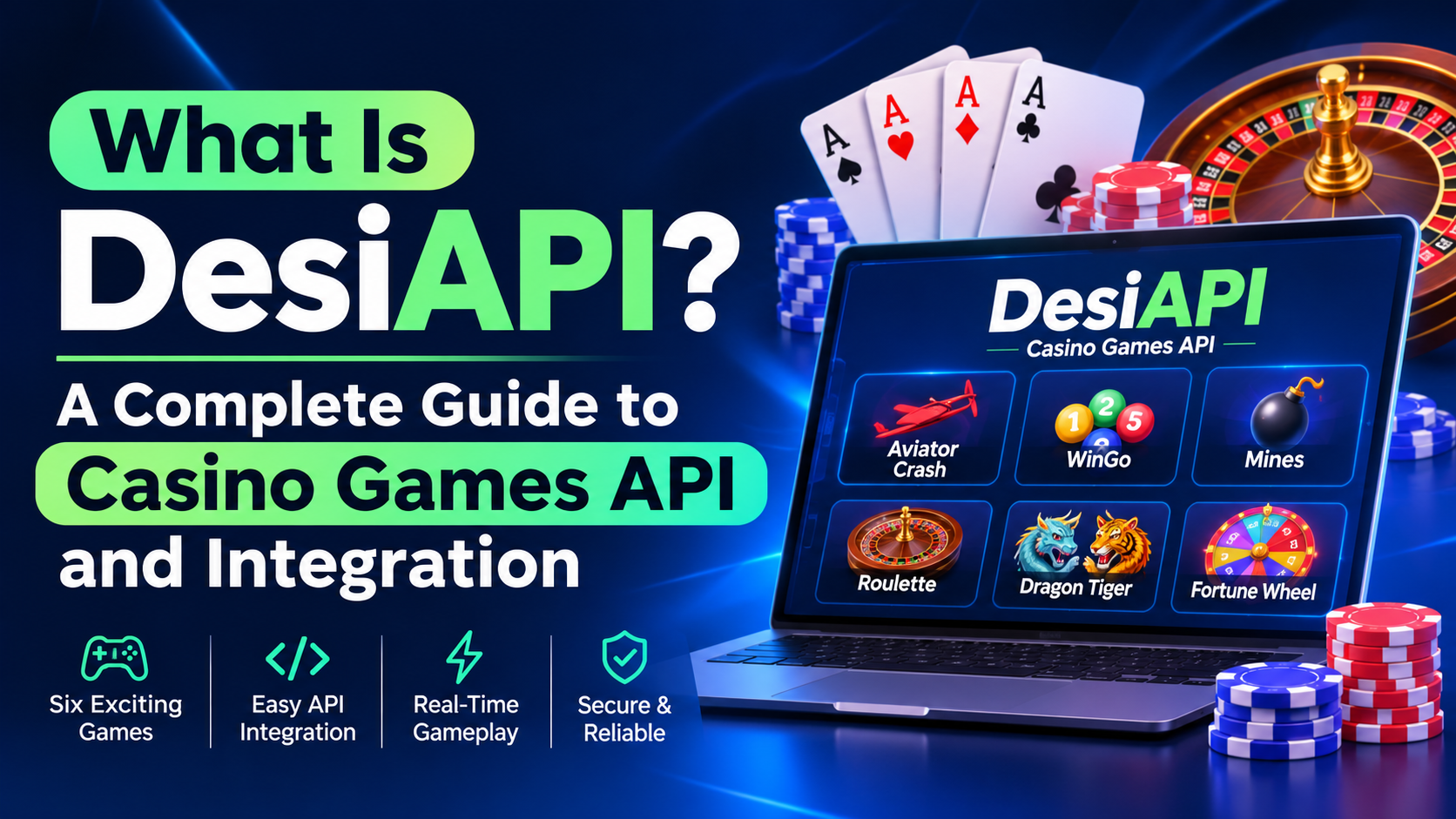
DesiAPI provides its own game implementations that businesses can integrate into their existing websites and applications.
Its current game catalogue includes six titles.
1. Aviator-Style Crash Game API
Crash games use a rising multiplier mechanic where players make decisions during a game round.
A Crash Game API allows a supported crash game to connect with the platform's player sessions and wallet infrastructure.
2. WinGo Game API
WinGo is a colour and number prediction-style game.
A WinGo Game API allows businesses to add this game format to an existing gaming application through API integration.
3. Mines Game API
Mines is an instant-style game involving a grid-based selection experience.
A Mines Game API provides a way to connect the game with the platform's existing player and wallet systems.
4. Roulette Game API
Roulette is a table-game format based around a spinning wheel and game outcomes.
A Roulette Game API allows operators to add a roulette experience to their existing platform.
5. Dragon Tiger Game API
Dragon Tiger is a card-based game format with a simple comparison mechanic.
A Dragon Tiger Game API enables businesses to connect this game to their gaming application.
6. Fortune Wheel Game API
Fortune Wheel is a wheel-based game format with different possible outcomes.
A Fortune Wheel Game API can help businesses expand their game catalogue with another instant-style experience.
What Should You Check Before Choosing a Casino API Provider?
Not every API provider offers the same integration structure or technical capabilities.
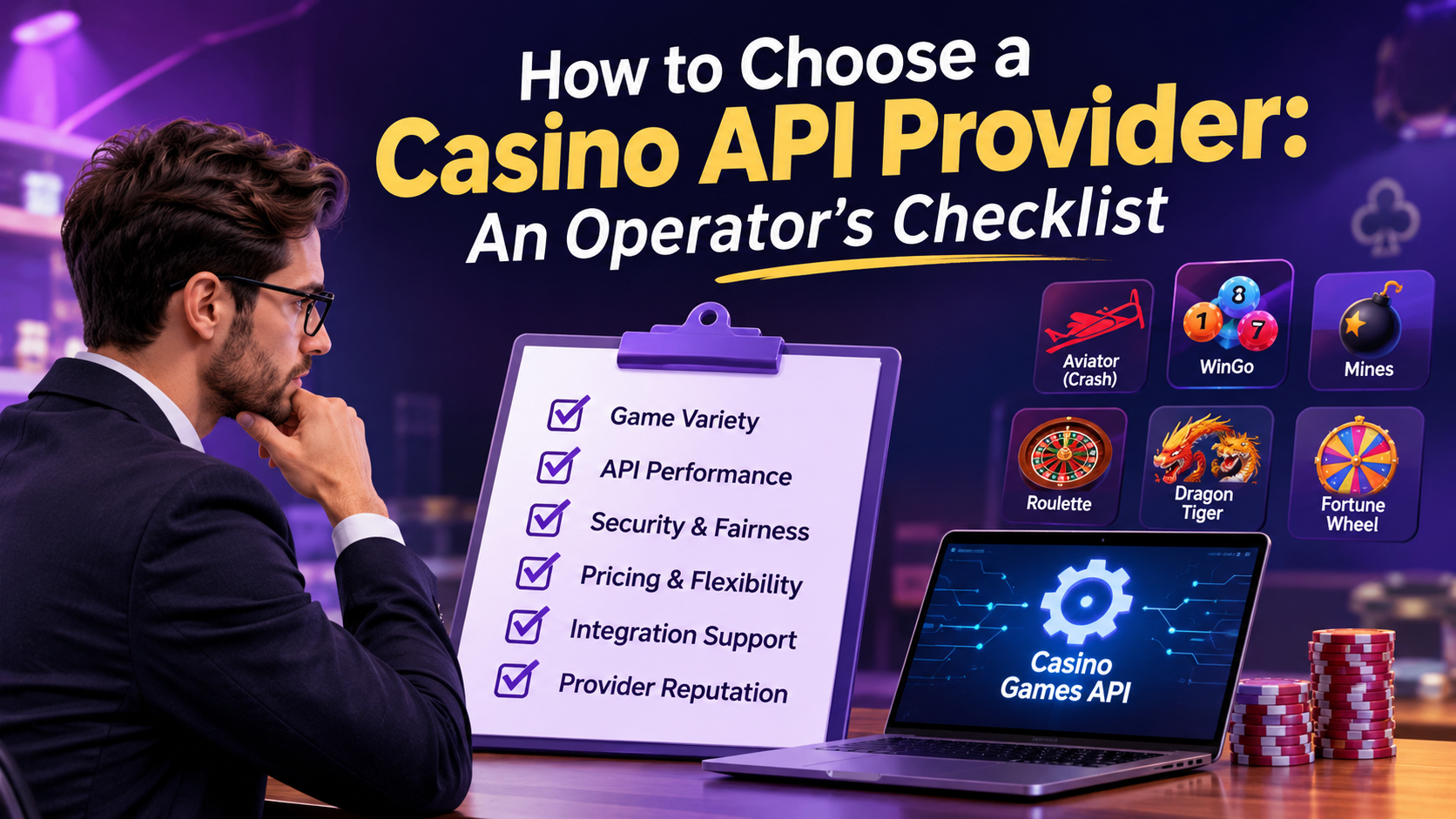
Before selecting a Casino API provider, businesses should evaluate the following points.
1. Game Catalogue
Check which games are available and whether they match your platform's requirements.
2. API Documentation
Proper documentation should explain authentication, session creation, game launching, callback requests, and response formats.
3. Player Session Management
Understand how player sessions are created, validated, expired, and terminated.
4. Wallet Compatibility
Check whether the API supports your existing wallet architecture or requires additional development.
5. Transaction Callbacks
Confirm how balance checks, bets, payouts, refunds, and transaction failures are handled.
6. Administrator Controls
Check whether the provider offers game settings, player activity information, round history, and reporting features.
7. Testing Environment
A public demo or sandbox environment can help developers understand the game experience and test the integration before production deployment.
8. Technical Support
Ask about integration assistance, troubleshooting, documentation updates, and ongoing technical support.
9. Commercial Terms
Understand the Casino API pricing structure, supported games, integration requirements, and any recurring commercial charges before proceeding.
Common Casino API Integration Mistakes to Avoid
Even a well-planned integration can face problems if important technical details are overlooked.
Here are some common mistakes developers should avoid.
- Ignoring duplicate transactions: Repeated callbacks should not result in multiple wallet deductions or credits.
- Weak session validation: Invalid or expired player sessions should be rejected.
- Slow wallet responses: Delayed callbacks can interrupt the gameplay experience.
- Missing transaction logs: Every important wallet operation should be recorded for investigation and reconciliation.
- Incomplete error handling: Developers should prepare for failed requests, network interruptions, and unexpected responses.
- Insufficient testing: Test successful bets, failed bets, payouts, refunds, and session expiry before launching.
- Ignoring security: API credentials and sensitive session information should be protected.
Testing these areas before production deployment can help reduce integration issues.
Why Businesses Choose DesiAPI for Casino Games API Integration
DesiAPI is a Casino Games API provider offering its own game implementations for businesses that want to connect additional games to their existing websites and applications.
Rather than requiring businesses to build every supported game from scratch, DesiAPI provides API connectivity designed around existing player accounts and wallet infrastructure.
The current catalogue includes:
- Aviator-style Crash
- WinGo
- Mines
- Roulette
- Dragon Tiger
- Fortune Wheel
Key DesiAPI Features
Player Session Connectivity
Connect supported games with existing player accounts through player session functionality.
Wallet Integration
Connect game activity with the platform's existing wallet through balance checks and transaction callbacks.
Bet, Payout, and Refund Callbacks
Support the communication of important game-related wallet events.
Administrator Controls
Manage available administrative settings and controls.
Game Settings
Configure supported game settings according to the available integration options.
Round History
Access game round information for monitoring and reference.
Reporting
Use reporting features to review relevant platform and game activity.
Public Game Demos
Explore supported games through public demos using virtual credits.
Designed for Existing Gaming Platforms
DesiAPI is intended for businesses that already operate or are developing a gaming website or application.
Its API-based approach allows developers to connect supported games with existing platform components rather than rebuilding the entire player account and wallet infrastructure.
For software development companies, gaming platform owners, and operators, this can provide a practical way to extend an existing game catalogue.
Frequently Asked Questions About Casino API Integration
1. What is a Casino Games API?
A Casino Games API is a software interface that allows a website or application to connect with supported casino games. It enables communication between the gaming platform and game environment, including game sessions and relevant wallet transactions.
2. What is player session integration?
Player session integration connects an authenticated platform user with a game environment. It allows players to access supported games through their existing accounts using a validated session.
3. What is seamless wallet integration?
Seamless wallet integration allows a gaming platform to maintain the player's balance while the game environment communicates with the platform through API callbacks for balance checks, bets, payouts, and refunds.
4. Can casino games use an existing player wallet?
Yes. Depending on the provider's supported integration model, casino games can connect to an existing player wallet rather than requiring a separate wallet for each game.
5. What is the difference between a game session and a wallet connection?
A game session controls access to a game for an authenticated player. A wallet connection handles balance information and transaction operations. Both components work together during gameplay.
6. What is required for Casino API Integration?
Common requirements include an existing gaming platform, player account system, backend development capabilities, API credentials, session management, a compatible wallet, and a secure callback endpoint.
The exact requirements depend on the provider's API documentation.
7. Which games can be connected through DesiAPI?
DesiAPI currently offers six game implementations: Aviator-style Crash, WinGo, Mines, Roulette, Dragon Tiger, and Fortune Wheel.
8. Does DesiAPI provide its own games?
Yes. DesiAPI provides its own game implementations and offers API connectivity for businesses looking to integrate them into existing websites and applications.
9. How much does Casino API Integration cost?
Casino API pricing depends on the provider, available games, integration requirements, commercial terms, and support arrangements. Businesses should request pricing details and confirm the complete commercial structure before selecting a provider.
10. Can developers test games before integration?
Public demos and testing environments can help developers explore the game experience before production integration. DesiAPI also provides public demos with virtual credits.
Final Thoughts
Casino API Integration is not simply about adding games to a website. It involves connecting different systems so that player accounts, game sessions, wallet balances, and transaction records work together correctly.
Understanding player session management and wallet connectivity can help businesses make better technical decisions before choosing a Casino Games API provider.
For businesses looking to expand their existing gaming platforms, DesiAPI offers six game implementations with API connectivity, player session functionality, wallet callbacks, administrator controls, round history, reporting, and public demos.
Visit https://desiapi.com/ to explore the available games and learn more about Casino Games API integration for your existing platform.
Looking for a Casino API provider for your website or application? Explore DesiAPI and discuss your integration requirements with the team.
Note: Casino and real-money gaming services are subject to applicable laws and licensing requirements. Businesses should verify the legal requirements in every jurisdiction where they intend to operate.
Review the Casino API integration flow, explore API pricing and quote requirements, or send your project brief to DesiAPI.